Altar Bible
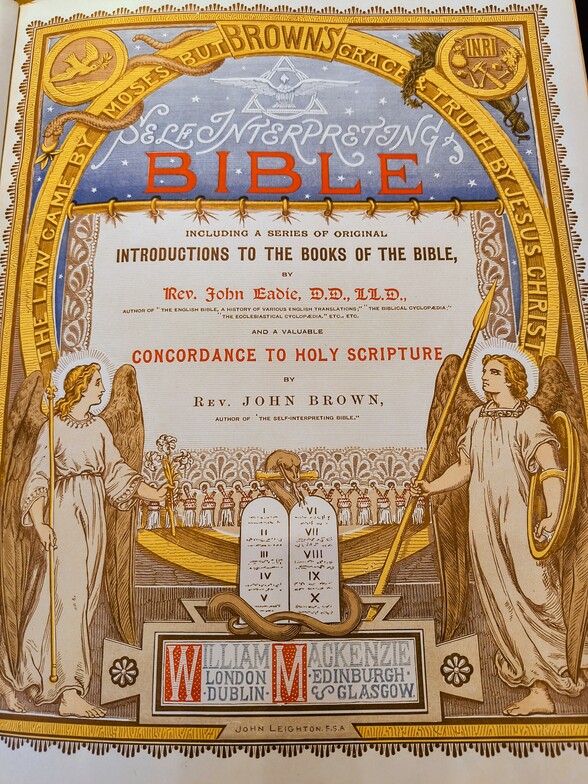
From Lumo AI: This is Brown's Self-Interpreting Bible, a famous family Bible edition — and the chromolithographed decoration suggests this is a later Victorian printing, probably from the 1860s–1880s. Here's what I can tell you:
The original author. The "Rev. John Brown" named here descends from John Brown of Haddington (1722–1787), a self-taught Scottish Presbyterian minister who was orphaned young and famously taught himself Latin, Greek, and Hebrew while working as a shepherd. He first published his Self-Interpreting Bible in 1778 — a Bible printed with extensive running commentary, marginal references, and explanatory notes so that readers could understand Scripture without needing a library of other works. It became one of the most popular study Bibles in Scotland and among Presbyterians in North America for over a century.
This particular edition. The title page shows additions that mark it as a much later revision:
Introductions by Rev. John Eadie, D.D., LL.D. (1810–1876), a Scottish theologian and biblical scholar known for his commentaries on the Greek text of Paul's epistles and his Ecclasiastical Cyclopaedia. Eadie also wrote The English Bible, a history of English translations, which the title page cites. His involvement places this edition around the 1860s–1870s.
A concordance — the Victorian family Bibles typically bundled concordances, dictionaries, maps, and engravings into one massive illustrated volume.
Publisher William Mackenzie of London, Edinburgh, and Dublin/Glasgow — a firm well known for lavish, color-printed gift Bibles. That vivid red, blue, and gold chromolithography, the angels flanking Moses and Christ panels (labeled "The Law given by Moses" and "Grace & Truth by Jesus Christ"), the Ten Commandments tablets, and the serpent motif all typify their elaborate Victorian Bible production.
The symbolism. The two arches framing the page visually enact the book's theological program: the Law (Moses) on one side, Grace and Truth (Christ) on the other, with the INRI cross emblem in the corner roundel and the dove of the Holy Spirit in the triangle (a Trinity symbol) at the top center.